Monday, 9 July 2012

The Mental Side of Golf...


Golf has never been an considered a physical sport of exertion; however, the fluidity of the perfect golf swing is addictive to both professional and amateur and drives one to take the game to the next level. The interesting part is: The competition is primarily ‘You’.

Producing that perfect golf swing requires a complex coordination of muscles in the human body, ranging from the scapular muscle in the shoulder all the way to the gluteus muscle behind the quadriceps. This means the perfect golf swing is achieved by practice and repetition, (similar to improving your math… or maybe a dance step), imprinting on the mind what one hopes to achieve by sending the electrical impulses to the required muscles. Unfortunately this is not an exact science as it takes time for the brain to reinforce this coordinated movement; as a result one occasionally has a bad shot, when the brain defocuses and triggers the wrong combination of muscles. Harnessing the brain to enable the execution of a pre planned strategic shot requires training and focus beyond what the brain is normally called upon to do.

This aspect of golf has always fascinated me, where the sport is really a harnessing of one’s mind and the calmer mind is the better one to play with. Every person who has played the game reasonably well is aware of this. Unfortunately one does not really perform many mental exercises to prepare for a round, even ones as simple as running through the entire round in the mind before play. Over the years, the link between the game of golf and the ‘mental side’ has only gotten stronger, so that now even amateur golfers looking to improve their game are encouraged to harness the power of the mind.

In recent times Neuro Linguistic Programming (NLP) has become popular, especially in the area of self help and development. NLP utilizes the power of positive thought to encourage and bring about a positive change in behavior of an individual. This process operates at the subconscious level of the human brain and the changes made can be subtle. Yet the effect it has on ones outlook and even performance is dramatic.
Can there be a marriage of these two ideas? As a single digit handicapper, is it possible for mental training and technique to take ones game to the next level? Even for the average golfer, can a little more concentration over a putt, or a more positive outlook on a certain shot lead to more consistency, thereby positively impacting one’s game? As discussed the golf swing is a coordinated movement of a number of moving parts, with the control center in the brain. Anything that can enhance this brain control will certainly impact the attitude and physical output of the golfer in his game.

There are golfing comments, ‘not to think too much over a shot’ and ‘take ones head out of the game’ but the key to this is mental detachment is not systematically taught. Good mental training can benefit the golfer as he strives to take his game to the ‘next level’. I believe NLP could be one such idea to achieve this… Could there be any other? Golf is not about hitting that 300 yard drive once; it’s training your mind to hit that 280 yard drive 18 times in a row, right down the middle.

Tuesday, 19 June 2012

Some Final Thoughts After my Visit


On this trip I was exposed to three very distinct styles of golf, and threes of the most common seen in India today; the extremely private and exclusive golf development, the association style of club, and army golf. It is interesting to see that golfing as a hobby or as an interest has always been part of the history of an area, be it in an army golf course or association style. Now there is a third dimension being added that of the luxury golf courses. In the next few years the golf industry is bound to transform as interest in the game is increasing. Barely a few years ago members of the armed forces would have laughed if their junior officers had even suggested that they wanted to learn and play golf. Now there are inter battalion tournaments and in some courses they help the officers themselves become better golfers!

Unfortunately I have slowly begun to realize that golf is heavily influenced by the area that it is in. for instance in the metros of India, developing and encouraging people to take interest in the game is much easier than if one was in a tier 3 city. On the other hand the metros also serve as a model to replicate for other cities as people tend to be aspirational and want to emulate the lifestyle they see in the metros. In either instance the sport must trickle down to encourage more participation from various sections of society, golf needs to be embraced by many other individuals. And all three styles of golfing developments can serve to do this. I am confident in the future there are going to be many more cities with such a variety of developments attached, the golf bug seems to be spreading and it is exciting to see where next it strikes!  

Poona Golf... Army Style


Golf has been a part of the history of Pune. With the Poona club being one of the oldest courses in the city along with the 3 other army courses, the EME course, NDA Course and RSI Southern Star golf course.  In fact a tournament is organized between these four courses, and is played to this day. This is one of the oldest tournament shields being played in the country. The third stop on my visit takes me to the RSI Southern Star Army golf course, one of the four in the said tournament shield.

This course was created a number of years ago during the British raj and was used only by the military stationed in the area. To this day it remains so, with only military personnel (ex service or existing officers) being allowed to use the club. However, this course does have an understanding with the members of the Pune club where a reciprocal arrangement has been created, but they are the only civilians who are allowed to the use the club.

Being a small course, some holes double back on each other
The RSI golf course is located in the cantonment area of the army and close to the residents quarters for the officers and ex service men. The course is also short in length and of a compact design. Due to the short length one is able to finish a round in a short period of time, which makes it very popular as they can easily schedule their time around golf because it takes much less time to play. The course features American blue grass on the greens and tees. This golf course has a limited number of golfers who use it, much smaller than the Poona club etc, thus maintenance of the course is very expensive. The course thus follows only basic maintenance practices and ensures the fairways have good lies, with the greens and the tees being protected.

Some of the holes on the golf course are very unique. One hole runs right next to a railway station, with numerous locomotives passing by, which is sight one does not get to see very often on a golf course. The area on which the course is constructed is an environmental park and as a result there are a variety of trees and animals that inhabit the course. This land also contributes as a major lung for the city of pune.

A view of the finishing hole of the course
Unfortunately golf is a very restricted sport in the army that is generally played by officers and some junior officers. However in recent times there has been a shift in the mind set, especially with the armies mission Olympics and golf being named as an Olympic sport. One hopes that more young talent will be nurtured and encouraged to play the game.  Currently more than 50% of all the golf courses in india are controlled by the army. this can potentially be a huge resource if more personson are allowed to use these facilities. unfortunately like the pune course, entry to the army area is restricted for civilians thus the will and the interest to encourage the game must some from within the army. This depends on the commandant and the golf secretary, and since postings are only for three years in one area continuity of policies is questionable.

As interest in golf grows the army will become more willing to let individuals learn the game and golf becoming an Olympic sport is a huge support for this idea. In the few years since, there has been an increase in participation in inter service tournaments, and even some commands have begun to organize inter battalion and regiment golf tournaments. This is extremely encouraging especially with the amount of resource the army has. 

Oxford Golf and Country Club…Raising the Bar


The second stop on my trip to Pune took me to one of the newest luxury developments in the region, the Oxford Golf and Country Club. This project is located 5 km away from the city and covers approx 1100 acres of land. It marks the first major development that is close to the city of Pune (The Sahara Amby Valley is 1.5 hours away from Pune). This project envisages a large number of villas and bungalows that will surround the golf course, with some even nestled in the surrounding hills. The project shall also feature a five star hotel and one of the largest club houses in India on over 10,000 sqft. 

One of the many tough bunkers on the course
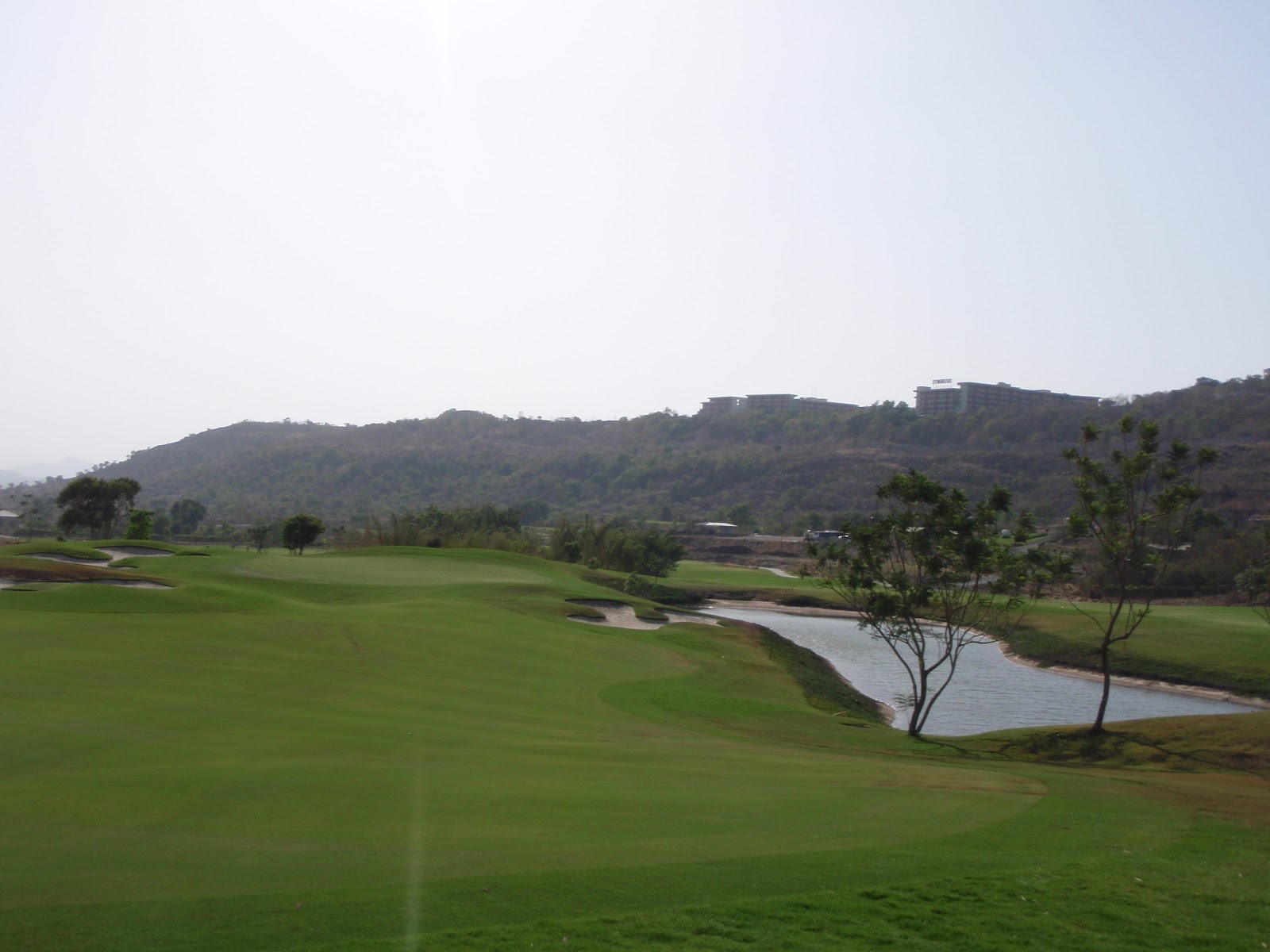
Although in its early stage, with only the golf course completed, it is truly spectacular as it is situated on the slopes that surround the Symbiosis Campus. The course is very tight and the greens are quick which make a deadly combination. However a few holes are wide and flat, offering some respite for the golfer. There are numerous sand traps both on the fairways and the green, requiring a solid mid iron game. The course features a Pas Palim grass though the green that is well maintained by a comprehensive and mechanized course maintenance department.

The style of golf on the course is different, where only carts are used and no walking is allowed (the golf course does offer caddies and fore caddies). The main reason for this was the length of the holes and the distances between greens and subsequent tees being greater than most courses. This style of golf is new with only a few golf courses moving in this direction and it remains to be seen how successful this will be. So far this course has 65 carts and plans add at least another 50 by the end of the year. So, as one can imagine, playing the course is on the expensive side, with green fees at Rs.3000 for a guest in addition to Rs.1000 for the cart and Rs.250 for the caddie. 

An Aerial View of the Oxford Golf Course
The Oxford Golf Club showcases a new style of golfing development that is becoming more popular in India. It is and a move away from the traditional stand alone courses. However, these projects continue to make golf more exclusive especially with the higher green fees. Unfortunately, creating a golf course requires high capital cost that can only be offset if there is another activity taking place on the land besides golf. Developments such as these showcase the potential for golf in the Indian market. Golf is a new idea, a new concept and it is difficult to predict what shape or form the industry will take. Here, golf is being used to project a lifestyle that is very different to what I experienced at the Pune Club golf course.

Surrounded by the Mountains...
This development, unlike the Pune Club is very new; 2-3 years old. it is just building a reputation and an image for itself, something the Pune Club course has been able to achieve by sheer dint of being around longer.  As the project continues to take shape, I am sure it will carve out a niche for itself in the Indian golf industry. I am very keen to observe the future of this course as it sets the bar high for new courses in India. In the coming months the massive club house will be completed as well as ground breaking for the hotel and other facilities. This poses some very real competition for the likes of Aamby Valley.


The bar just keeps being raised as I visit more courses throughout this beautiful country.

The Poona Club


Poona over the past few years has been developing rapidly especially as the Mumbai is busting at the seams. In the past few years a number of corporations have set up their operations there and have contributed in a major way to the further development of the city. The recent introduction of the Mumbai-Poona express way; has only helped matters as connectivity between these two cities has greatly improved something that many other states are hoping to emulate. The game of golf as well has seen a similar increase in interest. From just a few army courses where entry was restricted and one accessible golf course the Poona Club Golf Course, the city has grown to have two golf developments, the Aamby Valley City and the Oxford Golf and country club and a few more on the cards. The first stop on my visits to the golf clubs here takes me to the historic Poona Club Golf Course.

The Poona Golf Club is one of the oldest courses in the city at just over 100 years. It has been part of the city for time immemorial. The golf club was initially started by the British who were stationed there. Once the British left it was handed over to its name sake, the Poona Club to be maintained and managed by them. The Poona Club is a very old club and one of the most prestigious in the city. Since then the course has been managed by them, initially for the members of Poona Club only. In recent past the course has allowed people to become members of the golf club only, separate from the Poona club, as it became un feasible with the total number of members at the Poona Club totaling close to 4000.  

The course at the Poona Club is well laid out. It is quite flat and also reasonably short. The longest hole on the course is just over 560 yards (must check that before posting). The layout of the fairways is also forgiving with not many fairway bunkers to trouble the golfer. the length of a few holes can be daunting to look at from the tee, but with only green side bunkers to deal with one can easily ‘go for the green’.  The course features an American blue grass on the greens and the tees. Unfortunately the fairways have almost been completely overrun by weeds. This has been one of the biggest problems for this course. a few years ago the course attempted to solve this problem by relaying the entire fairway. However, the weeds were back again nearly 3 years later. For now the course is choosing to protect the greens and the tees from the weed and some parts on the fairway where the original grass prevails. The rest the course is mowing down and make it as flat and playable as possible. 

One beautiful feature on this course however is the number of trees. This truly makes this course one of the most beautiful. the course has been trying for while to get more visiting guests and junior programs started in the club. The membership base that it has is able to sustain it through the season, but the course wants to attract more tournaments etc. One method it is using is to encourage a number of PGTI pros to train here. This is an intriguing idea; especially it is vying to become the home course for some top Maharastran pros. This idea moves away from the conventional idea of having a teaching pro with the golf course, but building a golf course around a few existing professionals and allowing members to be part of the privilege to use the same driving range they do etc…

Golfers in Poona seem to have been bitten by the golf bug many years ago, and it is safe to say that the enthusiasm for the game has not changed. After the summer season when the golfing season resumes this course is extremely busy, with a packed tee sheet on the weekends and at least a 100 people using the course during the day. One blot on this otherwise beautiful paradise is the weeds. I believe a probable cause could be the water it is using on the course, as it is not filtering the water before it sprays it. Maybe using some agents or a quick filtration unit could benefit the club, especially since it has a very active and enthusiastic golfing audience. 

If this is the start to my adventure in this city I cannot wait for the next…!

Tuesday, 22 May 2012

Golconda Golf


Hyderabad is truly a spectacular destination to travel to in the south. It is rich in history and has some of the tastiest biryani you will eat (…paradise biryani…yumm). Over the years this quiet town has slowly mushroomed into a sprawling well laid out city on the verge of becoming one of the new Metros of India.  Golf has been an important part of Hyderabad for a number of years. The army has many golf courses that were patronized by golf addicts from the city.  Over time the need arose to have a separate golfing facility of superior quality that would be committed to the development of the game in Hyderabad. Thus the Hyderabad Golf Club was born.

A view of the Golf Course
The Hyderabad golf club is located behind the Qutub Shai tombs, with the back drop of the Golconda Fort. This makes it a truly spectacular golf course. All the holes of the golf course are played in the shadow of the fort with some even skirting the fort wall. This golf course is close to 10 years old and the land was allocated by the Department of Tourism. Earlier this area was used as a garbage disposal area by the Hyderabad Municipality and it is safe to say the golf course is a welcome change. The total land allocated was 200 acres but the course is situated on only 75 acres of land. The remaining has been under litigation due to some environmental agencies opposing the construction of the golf course in such close proximity to a national heritage monument. In recent years many of the cases have been won, with the Archaeological Department itself claiming that the golf course would be a good buffer in the area, ensureing the surrounding areas do not fall into disrepair.

The Organic Water Treatment Plant
The layout of the golf course is incomplete being short in length with only 9 greens at present. This nine can be repeated with different hole locations to offer 18 holes for the time being. The greens are tight and prudent approach shots are necessary for the golfer. However the fairways are forgiving which takes some pressure off the golfer. The interesting aspect of this course is that it is completely self sufficient in water. In fact even during the harsh summer temperature of 38 degrees centigrade, the course is brilliant green! The course is conveniently located around a sewage drain and has developed its own sewage treatment plant and treats enough water to sustain the golf course 365 days a year. As this water is not potable, for other purposes, the course purchases water from the city but the savings from the water treatment plant are immense.  The grass on the course is a local variety and responds to the water used. The course features tiff dwarf on the greens and a local ‘dhup’ grass on the fairways.


A view from the club house
This visit provided a lot of food for thought. For one, could the development of golf courses around heritage structures be a solution to promoting the site and the game, especially since the tourism department has so actively endorsed it in this state? The idea of utilizing the sewage water offers another solution to the huge demand for water faced by any golf course. The treatment plant itself is fairly uncomplicated and uses organic techniques to treat the water, (percolation through the soil, settling and re percolated). I believe this golf club is poised to become one of the most beautiful in the country. In recent times the course has been able to resolve many of its issues and begin developing the latter part of the property. I eagerly look forward to revisiting this course which would have transformed itself and the heritage area around it. 

Saturday, 5 May 2012

Golfing in the territory of the ‘Super Kings’


For the past few years Chennai has dominated the cricket scene with the ‘Chennai Super Kings’ bagging the coveted DLF IPL championship two years in a row. Although it has had its share of cricket and tennis fans, there has never been such fervor in the game as expressed today. The game of golf too in Chennai has steadily been developing in terms of players and facilities and is all set to capture hearts and fans in this South Indian City.

In the last 5 years this city has witnessed an explosion in the number of golf courses. Earlier the city had one private golf course (the Madras Gymkhana) and a few army courses. Now the city has 3 private courses, another two in the pipe line and even a standalone driving range with a 9 hole executive course! One of the main reasons for the increase e in popularity of the sport is the growing number of MNC’s who have setup operations in Chennai. Another factor is the return of NRI’s (Non Resident Indians) who understand the importance of golf from a business and recreational perspective.
Interestingly golf has been a very old sport in Chennai, the 130 year old Madras Gymkhana being one of the oldest clubs in India, after the Royal Calcutta Golf Club in Kolkatta. In fact one of the oldest running shields in the golfing world is played between the Bangalore Golf Club (the third oldest course in India at 128 years) and the Madras Gymkhana Club.

On my visit to the golf course of the Madras Gymkhana, I discovered it is a unique 18 hole par  70 golf course located in the middle of the Madras Race Course (horse racing). The course covers 100 acres with tight fairways and small greens that demand accurate approach shots from the golfer. The course also features 3 par 5’s which demand prudent play with one of these par 5’s being 603 yards from the championship tee. During the summer the course plays slightly easier as the fairways are drier and the ball does not hold. The most interesting feature is playing golf in the shadow of the race course, where even on a non racing day, one can hear the din of cheers and the hype of the announcer as races and results of events held elsewhere are broadcast over the PA system. Golfing is allowed only on non racing days. I thought it was excellent use of vast land that lies unused on the inside of a racing track. The facilities and buildings of the turf club are shared with the golf course. 

One of the main challenges facing developers in the city is the availability of land. As the city of Chennai has expanded, the cost of land has more than doubled. This high cost also makes development of courses questionable, as the land could possibly be better suited for large scale housing which is a priority social need. Another challenge is water. Courses such as the Madras Gymkhana and the Officers Training Academy have an advantage because they are situated virtually in the heart of Chennai. However transport and availability of water tends to become more difficult and expensive for those located on the outskirts.
These constraints have been overcome by some of the golf courses. In fact, the Cosmopolitan Club has developed its own in house water treatment plant that enables it to reuse sewage water. The Madras Gymkhana Club has similar plans to purchase treated recycled water from a hotel nearby.

In recent times golf has been dormant in India, with only a handful of clubs offering membership and not much of an ‘active interest’ shown by the public for the game. Things are now changing. I believe that the change in how golf was perceived in Chennai could reflect a transformation in attitude towards the sport in other parts of the country as well. As the country develops, more people become affluent, the number of NRI’s return home and the inflow of foreign tourists and expats increase, demand for the game is bound to rise. In Chennai today, avid golfers are members of not one, but at least three golf clubs (the Madras Gymkhana, Cosmopolitan and the Kodai Golf Club). All this in the span of the last five years…  I cannot wait to see the transformation in golf in other parts of our country!